Spill Deck vs Spill Pallet: Modular Containment System Comparison
Spill containment systems cost facilities thousands in EPA fines when improperly selected, yet most buyers choose based on initial price instead of total compliance value. The spill deck vs spill pallet decision determines both regulatory compliance and long-term operational costs.
Key Takeaways:
- Modular spill decks support up to 8x more container configurations than fixed pallets
- Steel spill pallets cost 40-60% more upfront but last 3-5x longer than polyethylene alternatives
- EPA requires 110% containment capacity — deck systems achieve this with 25% less floor space
What Are Modular Spill Decks vs Traditional Spill Pallets?

Spill decks are modular containment systems that connect individual platforms to create custom-sized containment areas. Traditional spill pallets are fixed-size units designed to hold specific container configurations. Both systems provide secondary containment for chemical storage, but their structural approaches differ significantly.
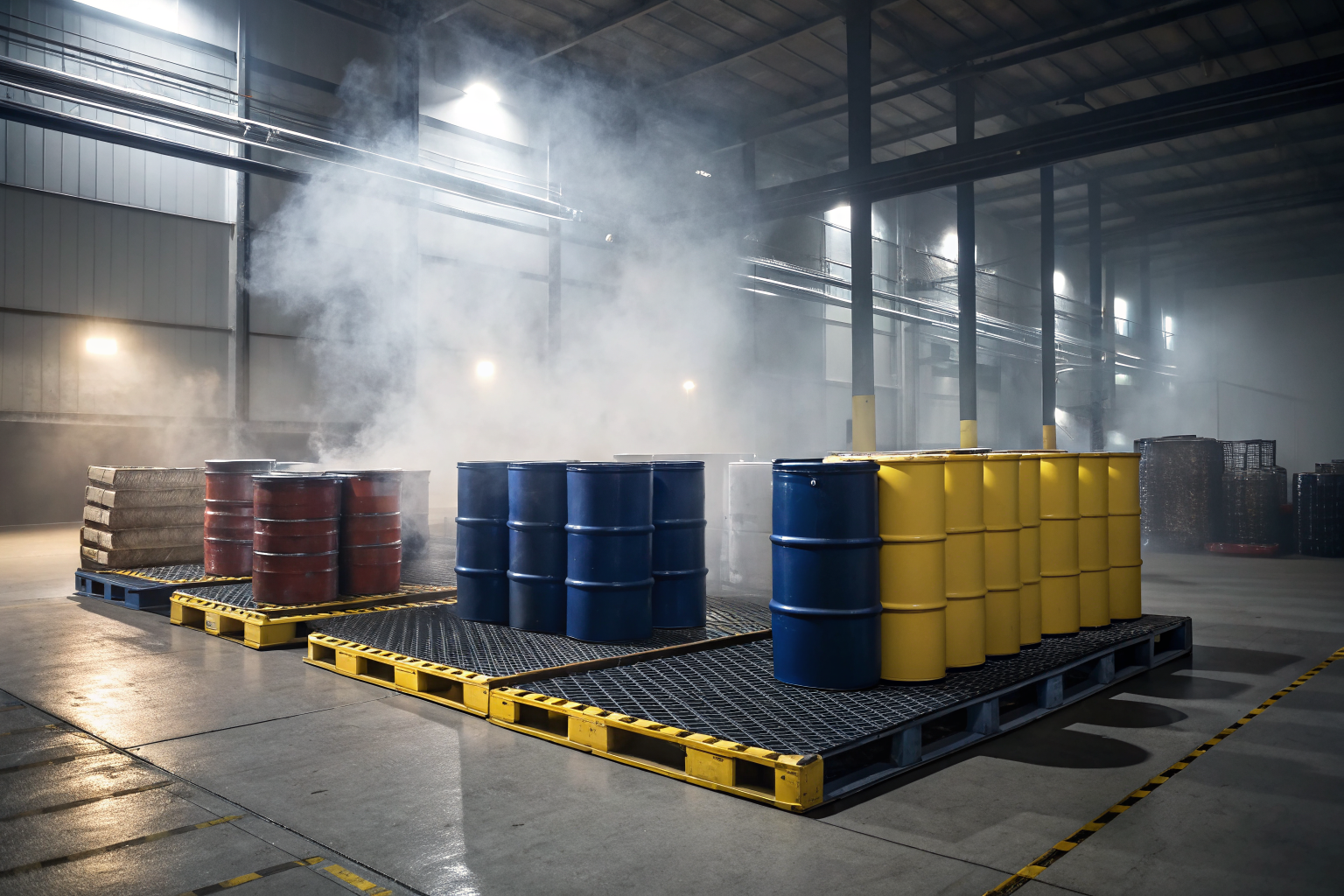
Modular spill decks consist of interlocking platforms with removable grating surfaces. Workers assemble these units on-site to match exact storage requirements. The platforms typically measure 4 feet by 4 feet and stack or connect horizontally. This modular design provides configuration flexibility that fixed pallets cannot match.
Spill pallets use integrated containment basins with built-in platforms or grating. Standard pallet sizes accommodate 1, 2, or 4 drums with predetermined spacing. The containment basin forms a single unit that cannot be modified after manufacturing.
EPA regulations require secondary containment systems to hold 110% of the largest container’s volume or 10% of total stored volume, whichever is greater. Spill decks provide modular configuration flexibility to meet these capacity requirements across different storage layouts. Traditional pallets must be sized correctly during initial purchase since their containment capacity cannot be expanded.
The structural difference affects maintenance access and inspection procedures. Deck systems allow individual platform removal for cleaning or replacement. Pallet systems require complete unit handling for thorough maintenance.
Design Options: Modular vs Fixed Containment Systems

Modular design enables system scalability that fixed pallets cannot provide. Spill deck platforms connect through mechanical fasteners, tongue-and-groove joints, or overlap connections. This assembly method allows facilities to expand containment capacity by adding platforms without replacing existing infrastructure.
Expansion capabilities vary dramatically between system types. Modular spill decks support incremental growth as storage needs increase. A facility starting with 4 drums can expand to 16 drums by adding platforms to the existing configuration. Fixed spill pallets require complete replacement when storage requirements exceed their original capacity.
Container compatibility differences impact operational flexibility. Spill decks accommodate various container sizes including 30-gallon, 55-gallon, and 85-gallon drums plus intermediate bulk containers up to 330 gallons. The modular platforms adjust spacing between containers through platform positioning. Fixed pallets accommodate only their designated container types with predetermined spacing that cannot be modified.
Footprint efficiency affects facility layout options. Spill deck systems create continuous containment areas that maximize floor space utilization. A 12-platform deck system occupies 192 square feet while containing 24 drums. Equivalent coverage using fixed 4-drum pallets requires 240 square feet due to spacing requirements between separate units.
Assembly methods influence installation time and labor requirements. Spill deck platforms connect without tools in most cases, allowing rapid reconfiguration. Workers can modify layouts during operational downtime without equipment shutdown. Fixed pallets arrive ready to use but cannot adapt to changing operational requirements.
Configuration options multiply with modular systems. A basic 4-platform deck supports 64 different container arrangements compared to 8 arrangements possible with equivalent fixed pallets. This flexibility reduces inventory requirements since facilities need fewer specialized containment units.
Material Comparison: Steel vs Polyethylene Performance
| Property | Steel Construction | Polyethylene Construction |
|---|---|---|
| Load Capacity | 8,000-12,000 lbs/sq ft | 2,500-4,000 lbs/sq ft |
| Chemical Resistance | Excellent with coatings | Inherent resistance |
| UV Resistance | Requires protective coating | Excellent |
| Impact Resistance | High | Moderate |
| Temperature Range | -40°F to 200°F | -20°F to 140°F |
| Typical Lifespan | 15-25 years | 5-8 years |
| Maintenance Requirements | Periodic coating renewal | Minimal |
| Fire Resistance | Non-combustible | Combustible |
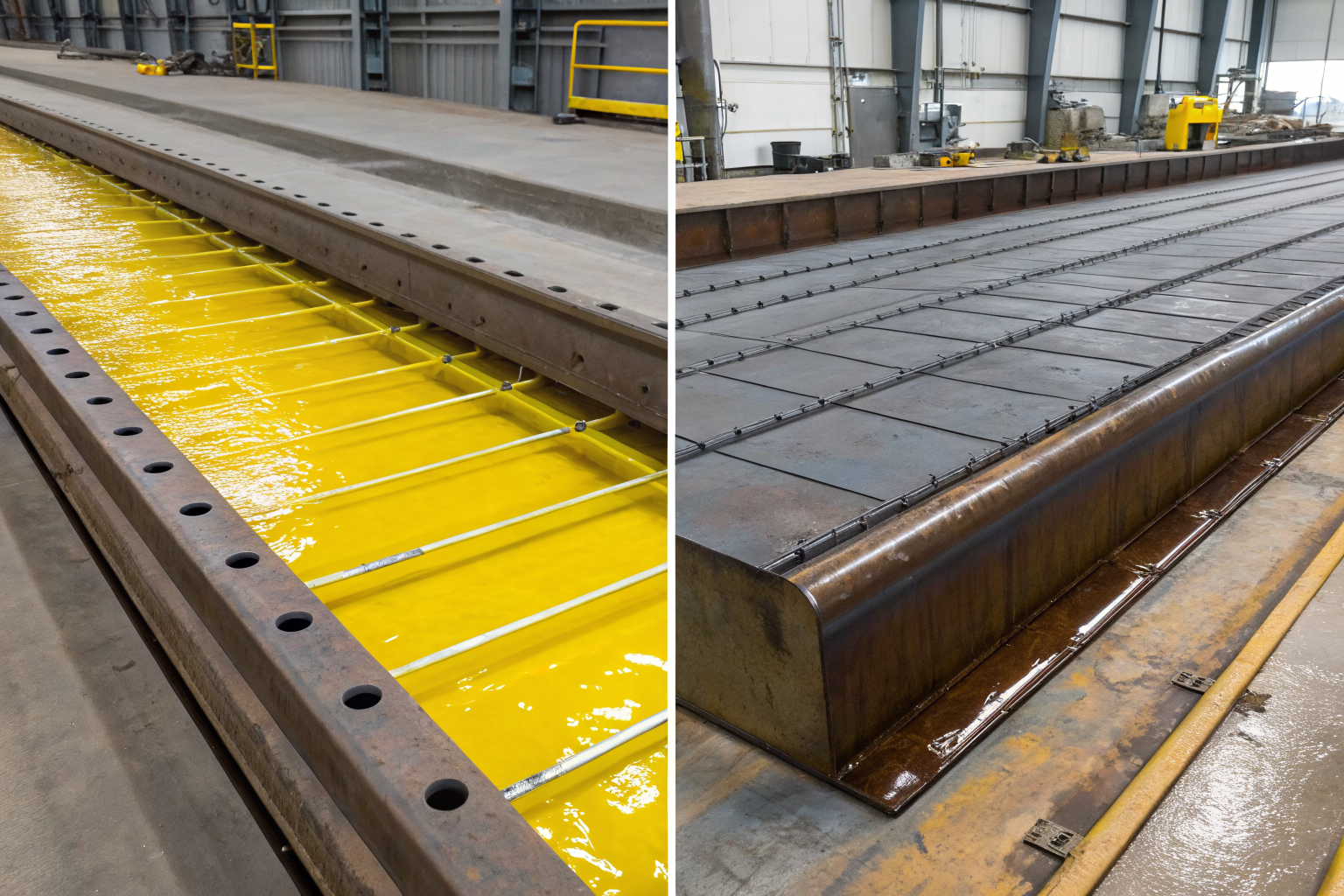
Material comparison determines long-term cost analysis for containment system selection. Steel construction provides superior load capacity for heavy container applications. Industrial facilities storing multiple 55-gallon drums need platforms rated for 8,000+ pounds per square foot. Polyethylene systems limit container density due to lower load ratings.
Chemical resistance varies by material composition and protective treatments. Steel systems require powder coating or galvanization to prevent corrosion from chemical exposure. These protective coatings provide excellent resistance to acids, bases, and petroleum products when properly maintained. Polyethylene offers inherent chemical resistance without protective treatments but can absorb certain chemicals over time.
Durability ratings affect replacement cycles and total ownership costs. Steel spill pallets withstand forklift impact, temperature cycling, and heavy use for 15-25 years. Polyethylene units show wear patterns after 5-8 years of industrial use. The durability difference becomes significant in high-traffic storage areas.
Maintenance requirements impact operational costs beyond initial purchase price. Steel systems need periodic inspection and coating renewal every 7-10 years. Polyethylene systems require minimal maintenance but cannot be refurbished when damaged. Replacement becomes necessary when structural integrity deteriorates.
Which System Meets EPA Regulations and SPCC Requirements?

EPA regulations mandate spill prevention compliance through specific secondary containment standards outlined in 40 CFR 112. Both spill decks and traditional pallets can meet these requirements when properly sized and installed, but their compliance approaches differ.
SPCC Plan requirements specify that secondary containment systems must prevent discharged oil from reaching navigable waters or adjoining shorelines. The regulations require professional engineer certification for facilities storing more than 10,000 gallons of oil. Spill prevention compliance depends on proper system sizing, installation, and maintenance regardless of the containment type chosen.
Regulatory compliance differences emerge in documentation and inspection procedures. Modular spill decks require individual platform inspection to verify connection integrity and containment capacity. Fixed spill pallets undergo inspection as complete units with fewer connection points to evaluate. Both systems need regular capacity verification and structural integrity assessment.
Inspection requirements focus on containment capacity maintenance and system condition. EPA inspectors verify that containment volume meets the 110% standard and check for cracks, corrosion, or damage that could compromise containment capability. Facilities must document inspection results and maintenance activities for regulatory compliance.
Enforcement patterns show that EPA violations most commonly result from inadequate containment capacity or compromised system integrity. Facilities receive citations when containment systems cannot hold required volumes or show structural damage. Proper system selection and maintenance prevent these compliance issues.
Documentation needs include capacity calculations, inspection records, and maintenance logs for both system types. SPCC Plans must identify specific containment systems and their locations within the facility. Regular updates ensure plan accuracy as storage configurations change.
Cost Analysis: Total Ownership vs Initial Investment

Cost analysis reveals product selection criteria that extend beyond initial purchase price to include operational and replacement costs. Steel spill decks cost $2,800-4,200 for 8-drum capacity compared to $1,800-2,400 for equivalent polyethylene systems. The 40-60% price premium creates initial sticker shock that obscures long-term value.
Total ownership calculations over 15 years show steel systems cost $3,200-4,800 including maintenance while polyethylene systems cost $4,500-6,000 including two replacement cycles. The durability advantage eliminates the initial price premium through extended service life.
Maintenance costs differ significantly between materials. Steel systems require coating renewal every 7-10 years at $400-600 per unit. Polyethylene systems need replacement every 5-8 years at full purchase price. Facilities using polyethylene face 2-3 replacement cycles during steel system lifespan.
ROI calculations for oil storage applications favor steel construction in high-use environments. Industrial facilities with daily container handling see payback within 8-12 years through reduced replacement costs. Lower-use applications may justify polyethylene selection when initial budget constraints outweigh long-term savings.
Replacement frequency data shows steel systems maintain structural integrity 3-5x longer than polyethylene alternatives. This durability advantage becomes critical in facilities where containment system failure creates regulatory violations or operational disruptions. The replacement scheduling burden alone justifies steel selection for many operations.